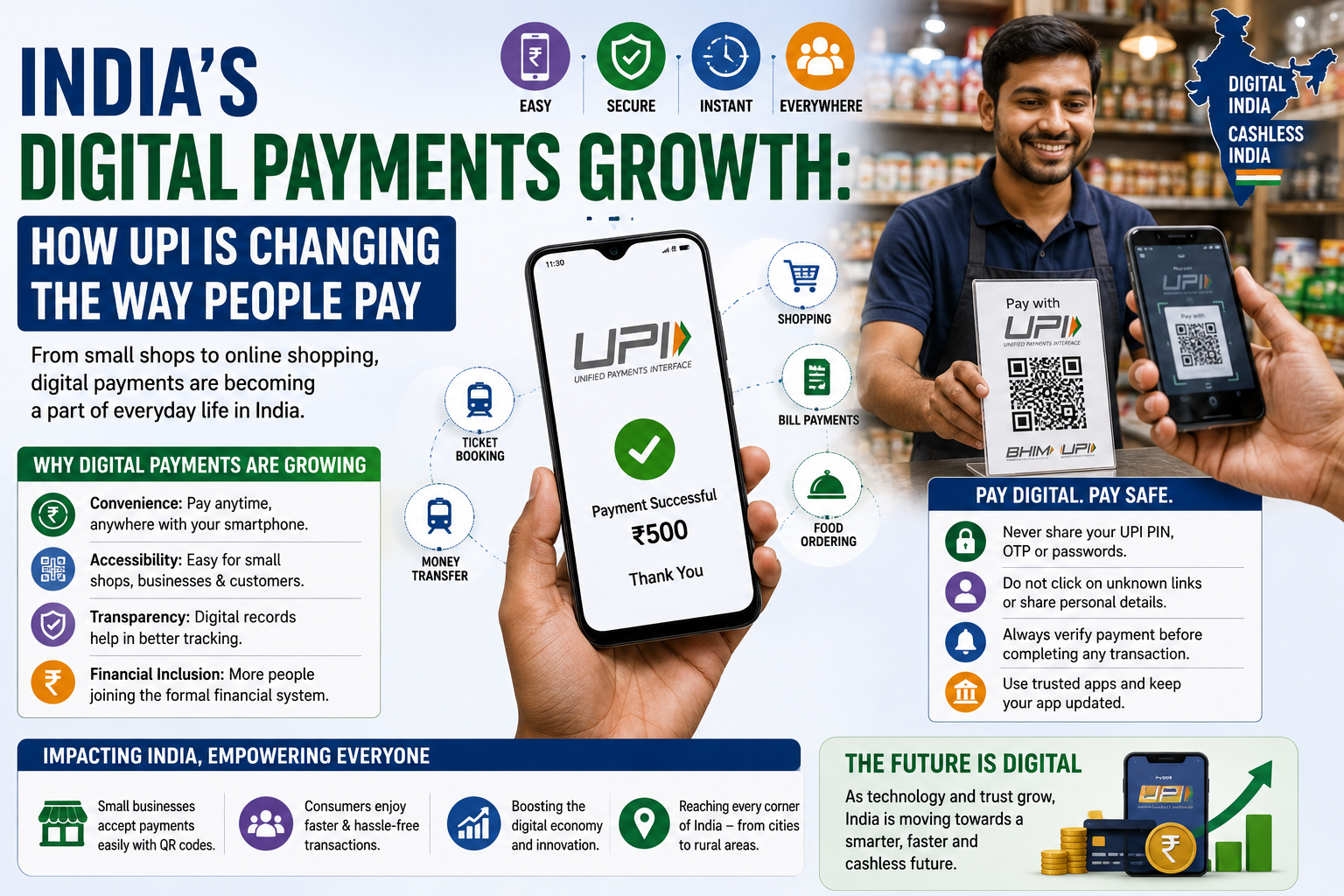
Digital payments have become a normal part of everyday life in India. From buying groceries at a local shop to paying electricity bills, booking tickets and ordering food online, people are increasingly using their phones to make payments.
One of the biggest changes in India’s payment ecosystem has been the growth of the Unified Payments Interface, commonly known as UPI. What was once considered a new payment method has now become familiar to millions of people across the country.
The interesting part is that digital payments are no longer limited to large cities. Small towns and local markets have also seen a major change in the way customers and shopkeepers handle everyday transactions.
UPI Has Made Everyday Payments Simpler
Before digital payments became common, customers generally depended on cash or cards for small purchases. Carrying cash was sometimes inconvenient, especially when people needed to make several payments during the day.
UPI changed this experience by allowing users to make payments directly from their bank accounts through supported mobile applications.
A customer can scan a QR code at a shop, enter the amount and complete the payment within a short time. The shopkeeper receives confirmation, and the transaction does not require the customer to carry physical cash.
This simplicity is one of the main reasons digital payments have become popular.
For small businesses, QR codes have also become a useful way to accept payments without requiring expensive equipment. A small tea shop, grocery store or roadside vendor can display a QR code and accept digital payments from customers.
Small Businesses Are Becoming More Digital
The growth of digital payments is particularly noticeable among small businesses.
Earlier, some small shop owners preferred cash because it was straightforward and familiar. Today, many of them accept multiple digital payment options.
For a small business, digital transactions can make it easier to maintain a record of payments. Instead of counting cash at the end of the day, the owner can check transaction history through the payment application or bank account.
However, digital payments also require users to understand basic online safety. Shopkeepers and customers need to be careful about fake payment screenshots, suspicious links and unknown requests.
A payment notification should always be verified through the bank or payment application rather than relying only on a screenshot shown by another person.
Digital Payments Are Also Changing Consumer Habits
The increasing availability of digital payment options has changed the way many consumers think about spending.
People can now make small payments without worrying about having exact cash. This has made digital transactions particularly useful for everyday purchases.
Online shopping has also contributed to the growth of cashless payments. Customers can pay for products and services through their phones while sitting at home.
For younger users, digital payments have become almost routine. Many people who use smartphones regularly are comfortable scanning a QR code or sending money to a contact.
At the same time, older users are gradually becoming familiar with these systems as well. Family members and local businesses often help new users understand how digital payments work.
Convenience Comes With Responsibility
Although digital payments offer convenience, users should not forget that financial transactions require caution.
One common mistake is sharing a UPI PIN with another person. A UPI PIN should be treated like an ATM PIN or banking password and should never be shared.
Another important point is that receiving money does not normally require entering a UPI PIN. If someone asks a user to enter a PIN in order to receive money, the person should stop and verify the situation.
Users should also avoid clicking on unknown links received through SMS, email or messaging applications.
Fraudsters sometimes use fake customer-care numbers, fake refund messages and misleading offers to convince people to reveal confidential information.
The growing popularity of digital payments means that awareness about online security is becoming just as important as the technology itself.
Rural Areas Are Also Part of the Digital Payment Story
Digital payments are not only a metropolitan trend.
As smartphones and internet connectivity become more widely available, digital transactions are becoming increasingly familiar in smaller cities, towns and villages.
Local stores can use QR codes to accept payments, while customers can transfer money without travelling to a bank or searching for an ATM.
For people living far from major banking centres, digital financial services can provide additional convenience.
There are still challenges, of course. Internet connectivity, smartphone availability, digital literacy and awareness about online fraud can affect how comfortably people use digital services.
Improving awareness and providing reliable connectivity will remain important as India’s digital economy develops further.
Why UPI Has Become So Popular
There are several reasons behind the popularity of UPI.
The first is convenience. Users can make payments directly through their smartphones without carrying cash.
The second is speed. Many transactions can be completed within seconds, although transaction times can sometimes depend on banks, applications and network conditions.
The third is accessibility. UPI-based payments are available through several banking and payment applications, giving users different options.
Another important factor is the widespread use of QR codes. Once a shopkeeper displays a QR code, customers can make payments without needing to exchange cash.
The combination of these factors has helped digital payments become a part of India’s everyday financial activity.
Digital Payments and the Future of Shopping
The growth of digital payments may also influence how businesses operate in the future.
Small businesses are increasingly using digital tools for payments, billing, inventory management and customer communication.
A business that once maintained everything in a physical notebook may now use software or mobile applications to keep basic records.
For customers, this can create a more convenient shopping experience.
However, cash is unlikely to disappear completely in the immediate future. Many people still prefer cash for certain transactions, and some areas may have limited connectivity or access to digital services.
The future is therefore more likely to involve a combination of payment methods rather than one method completely replacing everything else.
Digital Financial Literacy Is Becoming Important
As more people use online payment systems, financial literacy is becoming increasingly important.
Users should understand the difference between sending and receiving money, know how payment confirmations work and understand the importance of keeping banking credentials private.
Parents can also help older family members learn basic online safety practices.
Businesses should train employees who handle digital transactions and maintain proper records of payments.
Schools and educational institutions can also play a role by teaching students basic financial and digital safety concepts.
Technology can make payments easier, but responsible use is necessary to make the system safer.
What Users Should Remember
There are a few simple rules that every digital payment user should follow.
Never share your UPI PIN, ATM PIN, password or one-time password with anyone.
Do not approve a payment request unless you understand why you are receiving it.
Always check the recipient’s name and amount before completing a transaction.
Avoid downloading unknown applications or clicking suspicious links.
If a payment appears unusual, contact the bank or payment service through its official support channels.
Users should also be cautious when someone promises a prize, cashback or refund in exchange for completing an unfamiliar payment process.
These basic precautions can help reduce the risk of common digital-payment scams.
Conclusion
India’s digital payment ecosystem has changed significantly over the past few years. UPI has made it easier for consumers and businesses to transfer money and accept payments using smartphones.
The biggest change is not limited to technology itself. Digital payments are influencing everyday habits, small businesses and the broader way people interact with financial services.
As smartphone and internet usage continues to grow, digital payments are likely to remain an important part of India’s economy.
At the same time, convenience should always be balanced with security. Users need to understand how digital transactions work and remain careful with their financial information.
For businesses, adopting digital payment options can provide greater convenience for customers and help maintain transaction records. For consumers, it offers a quick way to make everyday payments.
The next phase of India’s digital payment journey will not only depend on faster technology but also on awareness, accessibility and responsible use. If these areas continue to improve, digital payments can become even more useful for people across cities, towns and rural communities.
SEO details
SEO Title: India’s Digital Payments Growth: How UPI Is Changing Payments
Focus Keyword: India digital payments
Secondary Keywords: UPI payments in India, digital payment growth, online payments, UPI transactions, cashless payments in India
Category: News
Tags: UPI, Digital Payments, India, Technology, Online Payments, Banking
Featured Image Alt Text: India digital payments and UPI growth
Excerpt:
Digital payments have become an important part of everyday life in India. Here is how UPI and other digital payment methods are changing the way consumers and small businesses make and receive payments.