Category: Jobs
Suggested Slug: government-jobs-india-exam-preparation-guide
Meta Description:
Looking for government jobs in India? Learn how to track recruitment notifications, prepare for competitive exams, manage documents and avoid common mistakes during the application process.
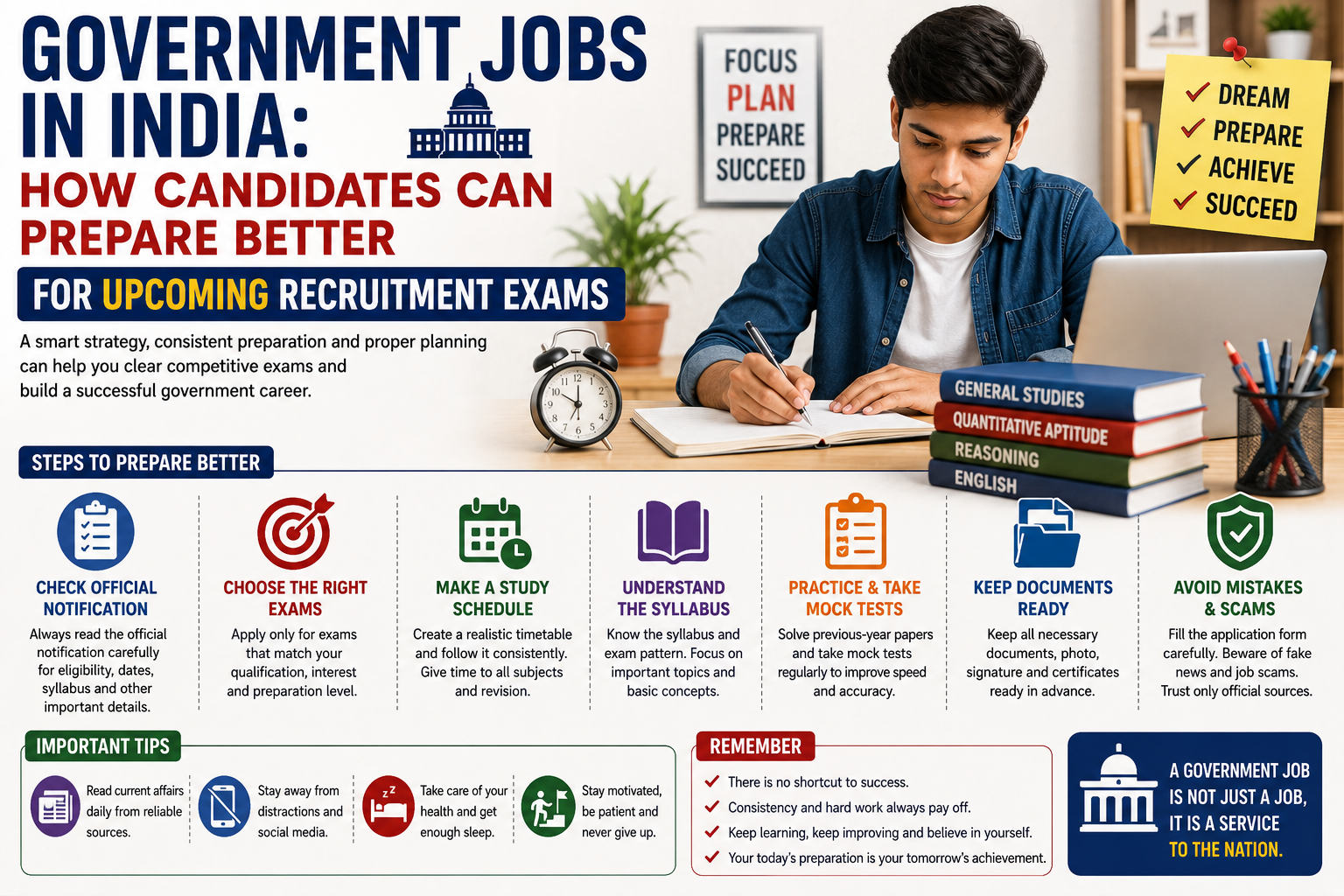
Government Jobs in India: How Candidates Can Prepare Better for Upcoming Recruitment Exams
Government jobs continue to attract a large number of candidates in India. Every year, students and job seekers prepare for different recruitment examinations conducted by central and state government departments.
For many candidates, the process can feel confusing at first. There are notifications to check, application forms to fill, documents to arrange and examinations to prepare for. Missing even one important date can sometimes create unnecessary problems.
The good thing is that candidates can make the process much easier by following a proper routine and keeping track of official information.
Instead of waiting until an examination notification is released, students can start preparing their basic subjects, documents and study schedule in advance.
Why Government Jobs Remain Popular
Government employment is considered attractive by many job seekers because of factors such as job stability, structured recruitment procedures and opportunities available across different departments.
Recruitment can take place for different types of positions depending on the department and examination.
Some vacancies may be suitable for candidates who have completed Class 10, while others may require Class 12, graduation, technical qualifications or specialised education.
Because eligibility requirements are different for every recruitment, candidates should always read the official notification carefully before applying.
A common mistake among applicants is assuming that every government job has the same eligibility conditions. In reality, age limits, educational qualifications, application fees, selection processes and examination patterns can vary considerably.
Start With the Official Notification
The first step after hearing about a recruitment opportunity should be checking the official notification.
Social media posts, videos and messages can help candidates discover that a recruitment process has started, but the final details should always be verified from the concerned official website.
The official notification normally contains important information such as:
- Number of vacancies
- Educational qualification
- Age limit
- Application dates
- Examination details
- Application fee
- Selection process
- Syllabus
- Important instructions
- Required documents
Candidates should save a copy of the notification after reading it.
This can be useful later if they need to check eligibility or application instructions.
Make a List of Suitable Exams
Students preparing for government jobs should avoid applying randomly to every vacancy.
A better approach is to identify examinations that match their educational qualification, interests and preparation level.
For example, a graduate may have several options available, while a candidate who has completed Class 12 may focus on recruitment where that qualification is accepted.
Making a simple list can help.
Candidates can divide opportunities into three categories:
1. Primary exams:
Examinations they are seriously preparing for.
2. Secondary exams:
Other suitable opportunities with a similar syllabus.
3. Backup options:
Recruitments that match their qualification but require different preparation.
This approach can reduce confusion and help candidates use their study time more effectively.
Build a Realistic Study Schedule
Preparing for a competitive examination does not necessarily mean studying for 12 or 14 hours every day.
Consistency is usually more useful than studying for very long hours for a few days and then losing momentum.
Candidates can create a daily schedule based on their available time.
A simple routine could include separate periods for mathematics, reasoning, general awareness, language and revision.
The exact subjects will depend on the examination.
The important thing is to create a schedule that can realistically be followed.
For example, a student who has college classes during the day may study for two or three focused hours in the evening.
Someone preparing full-time may be able to dedicate more time.
There is no single timetable that works for everyone.
Focus on Basic Concepts First
Many students make the mistake of immediately solving difficult questions without understanding the basic concepts.
This can make preparation unnecessarily stressful.
For subjects such as mathematics and reasoning, candidates should first understand the basic formulas and question types.
Once the fundamentals are clear, they can gradually move toward more difficult questions.
The same principle applies to other subjects.
A strong foundation can make revision easier later.
Practice Previous-Year Questions
Previous-year question papers can be extremely useful during examination preparation.
They help candidates understand the type of questions asked and the level of difficulty.
They can also show which topics appear frequently.
Instead of simply reading solutions, candidates should try solving questions themselves.
After completing a paper, they should check their mistakes and identify the topics where they need more practice.
Maintaining a small notebook of mistakes can be helpful.
For example, if a candidate repeatedly makes errors in percentage or time-and-work questions, those topics can receive additional attention during revision.
Mock Tests Can Improve Time Management
Knowing the syllabus is only one part of examination preparation.
Candidates also need to learn how to manage time during the actual examination.
Mock tests can help with this.
A candidate can begin with untimed practice and gradually move toward full-length timed tests.
After each mock test, the score should not be the only thing considered.
Candidates should also analyse:
- Which questions took too much time?
- Which answers were incorrect?
- Which questions were left unanswered?
- Which section caused the most difficulty?
- Were mistakes caused by lack of knowledge or careless reading?
This analysis can be more useful than simply taking another test without reviewing the previous one.
Keep Important Documents Ready
Government recruitment applications often require candidates to provide personal and educational details.
Depending on the recruitment, applicants may need documents related to education, identity, photographs, signatures, category or other eligibility requirements.
Candidates should keep digital copies of commonly required documents in an organised folder.
However, they should not upload any document unless it is actually requested by the official application process.
It is also important to ensure that names, dates of birth and other information entered in the application form match the relevant documents.
A small mistake in an application form can sometimes create complications later.
Be Careful While Filling the Application Form
Application forms should never be completed in a hurry.
Candidates should check every field before submitting the form.
Particular attention should be given to:
- Name
- Date of birth
- Educational qualification
- Address
- Mobile number
- Email address
- Category details, where applicable
- Examination centre preferences
- Uploaded photograph and signature
Before making the final submission, candidates should use the preview option if it is available.
After submission, they should save the confirmation page, application number or registration details.
These details may be required later to download an admit card or check the examination result.
Avoid Depending on Unofficial Information
The internet has made it easier to find recruitment information, but it has also made misinformation easier to spread.
Candidates may come across posts claiming that a particular examination date has been changed or that a new vacancy has been announced.
Such information should be verified before taking action.
The safest approach is to check the official recruitment website or the official notification.
Candidates should also be careful with websites asking for personal information, banking details or payments without clearly explaining the purpose.
Be Careful About Job Scams
Job seekers can sometimes become targets of fraudulent job offers.
A message may promise a government job in exchange for money or claim that a candidate has been selected without appearing for the required selection process.
Such claims should be treated with caution.
Legitimate recruitment processes generally follow an officially announced procedure.
Candidates should never pay an unknown person who promises guaranteed government employment.
If something appears suspicious, applicants should verify it through the concerned department’s official channels.
Current Affairs and General Awareness
Many competitive examinations include questions related to general awareness and current events.
Candidates should develop a habit of reading reliable news sources regularly.
Instead of trying to remember every piece of information, they can focus on important national and international developments, government initiatives, economy, science, sports and other topics relevant to their examination.
Making short notes can help with revision.
However, candidates should avoid spending most of their study time scrolling through social media in the name of current-affairs preparation.
A structured source and regular revision are generally easier to manage.
Take Care of Your Health During Preparation
Exam preparation can become stressful, especially when candidates compare themselves with others.
Long study sessions without proper breaks may reduce concentration.
Adequate sleep, regular meals and some physical activity can help maintain energy and focus.
Candidates should also remember that preparation is a long process.
One difficult mock test or one bad study day does not mean that the entire preparation has failed.
Progress should be measured over weeks and months rather than one particular day.
What Candidates Should Do After Applying
Submitting an application is not the end of the process.
Candidates should continue checking official updates after applying.
They should keep track of:
- Admit card release
- Examination date
- Examination centre
- Answer key
- Result
- Cut-off information, where applicable
- Further selection stages
- Document verification
- Final appointment information
Important updates should be checked through official sources rather than relying only on messages forwarded through social media.
Final Thoughts
Government job preparation requires patience, consistency and careful attention to official information.
Candidates who start early can give themselves more time to understand the syllabus, practise questions and improve weak areas.
A good preparation strategy does not need to be complicated. Understanding the examination, creating a realistic timetable, practising previous-year questions, taking mock tests and revising regularly can provide a strong foundation.
At the same time, candidates should be careful when filling application forms and should verify recruitment information through official sources.
There is no shortcut that can guarantee selection in a competitive examination. Every candidate has a different level of preparation, and results can depend on several factors.