Category: News
Suggested URL Slug: india-forex-reserves-record-729-billion
Meta Description: India’s foreign exchange reserves have reached a record $729.33 billion. Here is what the rise means for the rupee, imports, investors and the Indian economy.
India’s foreign exchange reserves have reached a new record level, crossing $729 billion, according to the latest data from the Reserve Bank of India (RBI). The development comes at an important time for the Indian economy, as global markets continue to deal with uncertainty around oil prices, interest rates, geopolitical tensions and currency movements.
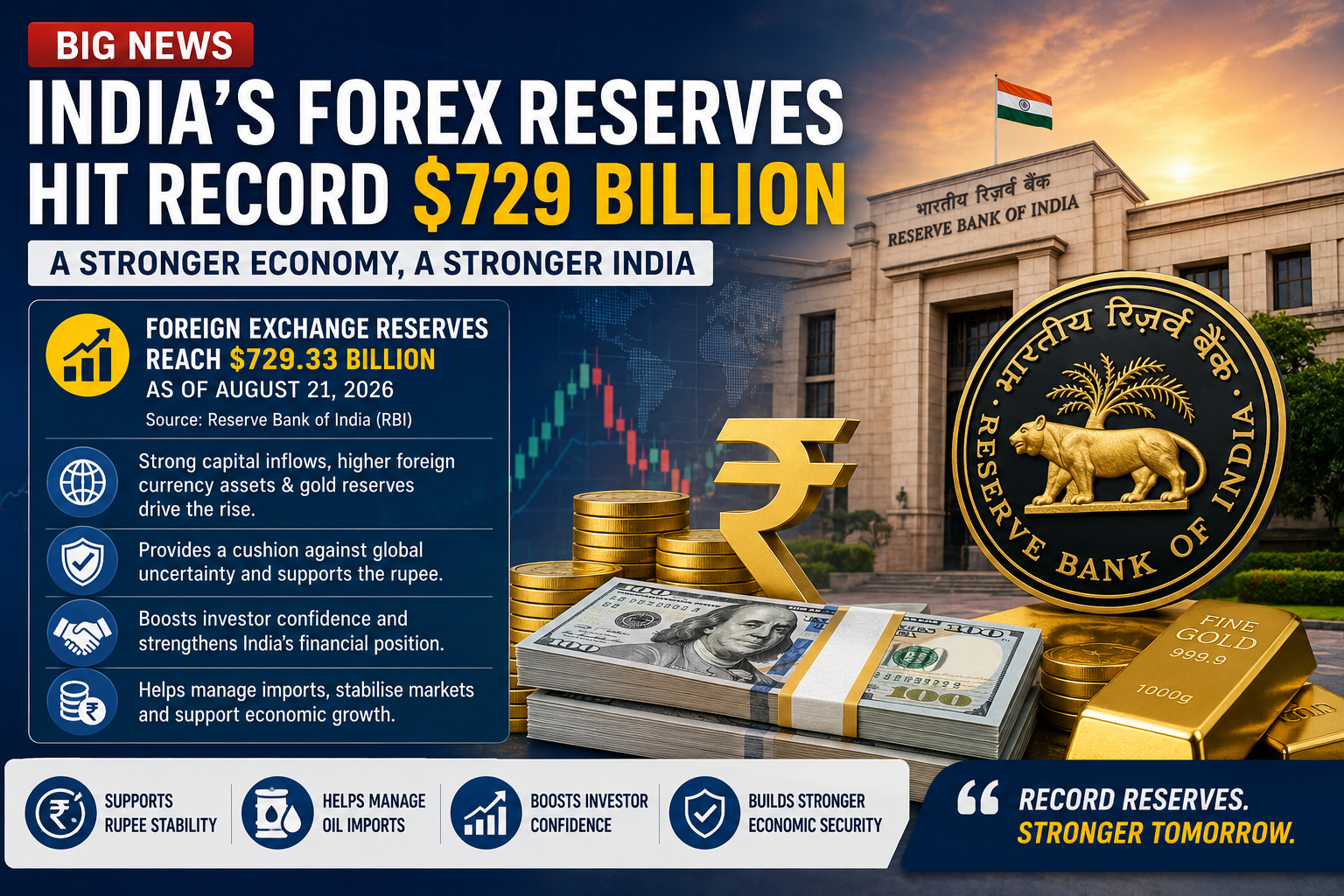
According to the latest figures, India’s foreign exchange reserves stood at around $729.33 billion as of August 21, 2026. The increase has been supported by strong capital inflows and a rise in foreign currency assets and gold reserves.
For ordinary people, a record forex reserve figure may sound like something that only matters to banks, investors or economists. But it actually has a connection with several parts of the economy, including the value of the rupee, the cost of imports, investor confidence and the country’s ability to handle external financial pressure.
What Are Foreign Exchange Reserves?
Foreign exchange reserves are assets held by a country’s central bank in foreign currencies and other forms. In India’s case, the RBI manages these reserves.
These reserves mainly include foreign currency assets, gold, Special Drawing Rights (SDRs) and India’s reserve position with the International Monetary Fund.
The main purpose of keeping a large reserve is to provide financial strength during periods of economic or market stress.
For example, India imports crude oil, electronic equipment, machinery and several other products from different countries. Most international trade is settled in major foreign currencies, especially the US dollar.
If the global financial environment becomes difficult or the rupee comes under pressure, a healthy reserve position gives the country more room to respond.
Why Have India’s Forex Reserves Increased?
One of the major reasons behind the recent increase has been strong capital inflows.
The RBI introduced measures earlier this year that encouraged foreign currency deposits and overseas borrowing by making hedging arrangements more attractive for certain transactions.
These measures helped bring a significant amount of foreign currency into the Indian financial system.
Between June 5 and August 21, the RBI accumulated a substantial amount through these measures, with a major portion coming from deposits by non-resident Indians.
The result has been a significant increase in India’s overall reserve position.
At the same time, changes in the value of gold holdings also contributed to the overall reserve figure.
The latest weekly increase alone was significant, with foreign currency assets and gold valuation contributing to the rise.
What Does This Mean for the Indian Rupee?
The forex reserve position is particularly important for the Indian rupee.
The rupee, like other emerging-market currencies, can be affected by movements in the US dollar, crude oil prices, foreign investment flows and global interest rates.
When foreign currency flows into India are strong, it can provide some support to the rupee.
However, it would be incorrect to assume that a record reserve automatically means the rupee will continuously strengthen.
Currency markets are influenced by many factors.
For example, if global oil prices rise sharply, India may need to spend more dollars on crude oil imports. Similarly, if international investors move money out of emerging markets, demand for dollars can increase.
Therefore, reserves provide a cushion, but they do not completely remove currency risks.
Why Are Forex Reserves Important for Common People?
A person may wonder how a $729 billion reserve affects their daily life.
There are several indirect connections.
India imports a large amount of crude oil. Fuel prices are influenced by international oil prices and currency movements. A stronger or more stable currency can reduce some pressure created by dollar-denominated imports.
Imported smartphones, computers, electronic components, machinery and industrial equipment can also be affected by currency movements.
Businesses that depend heavily on imports closely watch the rupee-dollar exchange rate because a weaker rupee can increase their costs.
On the other hand, exporters can sometimes benefit from a weaker rupee because their foreign earnings become more valuable when converted into rupees.
This is why currency stability is important for both businesses and consumers.
India’s Reserves Provide a Financial Cushion
One of the biggest advantages of having large reserves is that they provide a cushion against external shocks.
Global markets can change very quickly.
A geopolitical conflict, sudden increase in oil prices, financial crisis or sharp movement in US interest rates can create pressure on emerging economies.
During such periods, countries with stronger external balances generally have more room to manage the situation.
India’s record reserve position therefore provides an additional layer of financial security.
It does not mean the country is completely protected from global problems, but it does give policymakers more flexibility.
What Is Inside India’s Foreign Exchange Reserves?
India’s reserves are not simply a giant pile of US dollars.
The overall reserve figure consists of several components.
Foreign currency assets form the largest part. These include assets denominated in major international currencies.
Gold is another important component.
The RBI has also been increasing the importance of gold within its reserve management strategy over time. Changes in international gold prices can affect the value of India’s gold reserves.
The latest reserve data showed foreign currency assets of more than $590 billion, while gold holdings were valued at more than $114 billion.
There are also SDRs and India’s reserve position with the IMF.
Together, these components make up the country’s total foreign exchange reserves.
Is $729 Billion Enough?
There is no single number that can be described as “enough” for a country like India.
The size of an adequate reserve depends on several factors.
Economists generally look at a country’s import requirements, external debt, capital flows, currency risks and overall economic conditions.
India is a large economy with significant import requirements. It also has a large and growing international trade relationship.
Therefore, maintaining a strong reserve position is important.
At the same time, reserves can rise and fall depending on market conditions.
A record figure today does not guarantee that reserves will remain at exactly the same level in the future.
Foreign Investors Are Also Watching India
Foreign investors closely monitor India’s external financial position.
A strong reserve position can improve confidence because it indicates that the country has a substantial buffer of foreign assets.
Recent data also showed renewed foreign portfolio investment flows into Indian equities. Foreign portfolio investors reportedly invested more than ₹30,900 crore in Indian equities during August, marking another month of net inflows.
This combination of capital inflows and strong reserves is an important development for India’s financial markets.
However, investors still have to consider global interest rates, oil prices, geopolitical developments and corporate earnings before making investment decisions.
Global Conditions Remain Uncertain
Despite India’s strong reserve position, the global economic environment remains complicated.
Oil prices, US monetary policy and geopolitical tensions continue to influence financial markets.
Recent global market movements have shown how quickly investor sentiment can change when geopolitical risks increase. Higher crude oil prices can create additional pressure on countries that import large quantities of energy.
India’s large reserve position can help absorb some of these pressures, but it cannot completely isolate the country from global economic developments.
This is why policymakers continue to closely monitor currency movements and capital flows.
What Could Happen Next?
The direction of India’s forex reserves in the coming months will depend on several factors.
Foreign investment flows will be important.
Export earnings, imports, crude oil prices and the movement of the US dollar will also influence the country’s external balance.
The RBI’s policy decisions will remain another important factor.
If capital inflows remain strong and external conditions remain manageable, India’s reserves could remain at historically high levels.
But if global investors suddenly move money towards safer assets or energy prices rise sharply, pressure on reserves could increase.
For this reason, the record figure should be seen as a strong starting position rather than a guarantee about the future.
A Positive Sign, But Not the Whole Story
India reaching a record foreign exchange reserve level is certainly a significant economic development.
It indicates that the country currently has a substantial external financial cushion and has been able to attract foreign currency through different channels.
For the rupee, the reserve position can provide support during periods of market volatility.
For businesses, it can improve confidence around international payments.
For the wider economy, it provides policymakers with additional room to respond to external shocks.
However, forex reserves are only one part of the economic picture.
India also needs sustained economic growth, strong exports, stable inflation, investment and employment opportunities.
A healthy reserve position can support these objectives, but it cannot replace them.
Final Thoughts
India’s foreign exchange reserves reaching around $729.33 billion is an important milestone for the country’s economy.
The record level reflects strong capital inflows, changes in foreign currency assets and the value of gold reserves.
For ordinary citizens, the biggest takeaway is that India currently has a significant financial buffer against external economic shocks.
But the global economy remains unpredictable. Oil prices, currency movements, international interest rates and geopolitical developments can change the financial environment quickly.
For now, the record reserve level gives India an important advantage as it navigates these challenges.
The coming months will show whether capital inflows remain strong and whether India can maintain this comfortable external position while continuing to expand its economy.
SEO Keywords:
India forex reserves 2026, India foreign exchange reserves, RBI forex reserves, India reserves $729 billion, Indian rupee, RBI latest news, India economy news, foreign exchange reserves India