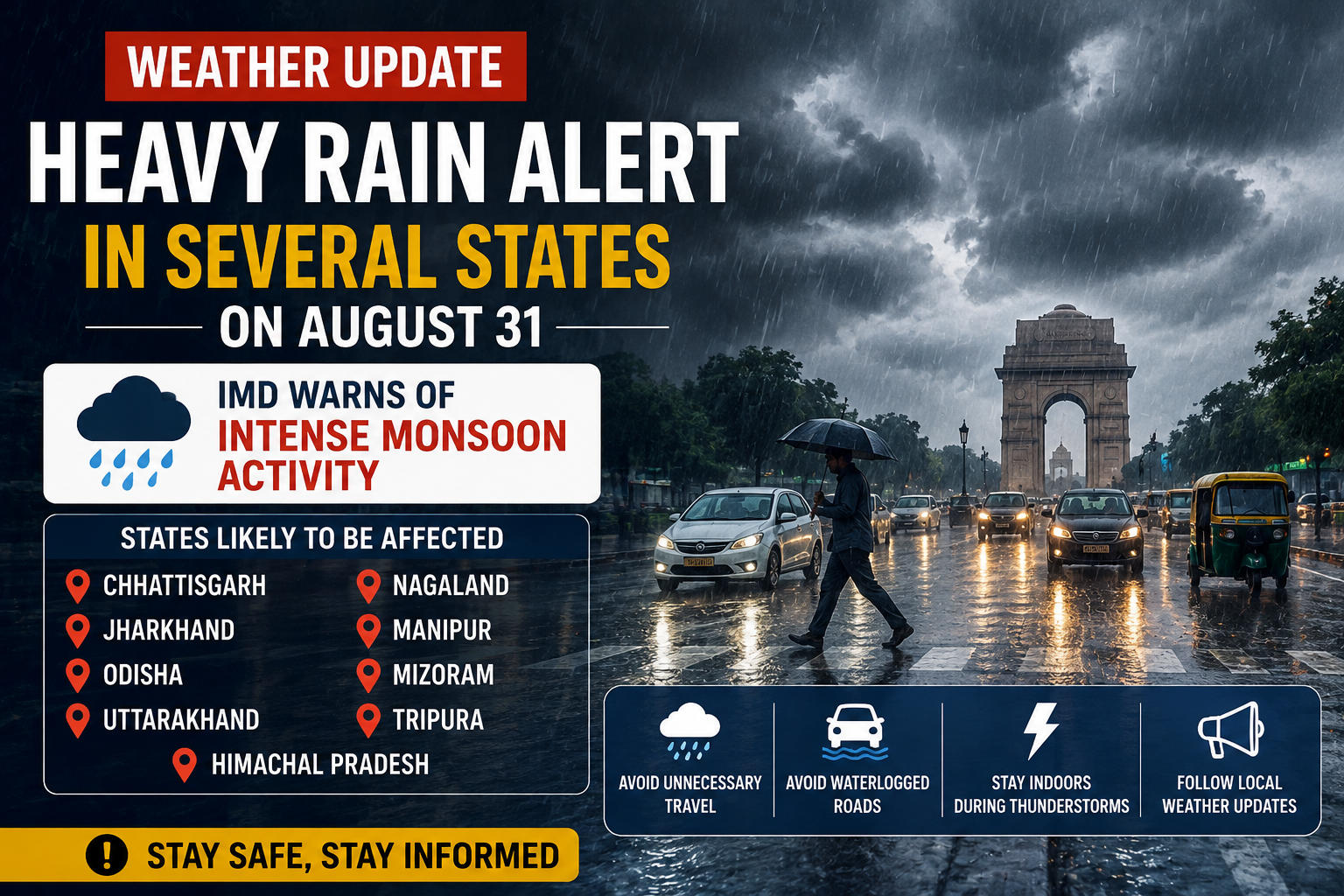
India Weather Update: Heavy Rain Alert in Several States on August 31, IMD Warns of Intense Monsoon Activity
India’s monsoon season continues to remain active across several parts of the country, with the India Meteorological Department forecasting heavy to very heavy rainfall in a number of states on August 31, 2026.
The latest weather forecast is important for people living in areas that have already experienced heavy rainfall in recent weeks. It is also useful for people planning road, rail or air journeys, as intense rainfall can sometimes lead to waterlogging, poor visibility, traffic problems and local flooding.
According to the latest forecast, Chhattisgarh, Jharkhand, Odisha, Uttarakhand, Nagaland, Manipur, Mizoram and Tripura are among the states where heavy to very heavy rainfall is expected at isolated locations. Parts of Himachal Pradesh may also receive heavy rainfall.
The weather situation is expected to remain active as the monsoon continues across different parts of India.
Heavy Rain Expected in Several States
The August 31 weather outlook shows that rainfall activity could affect several regions rather than being limited to one particular part of the country.
Eastern and central India are expected to experience significant rainfall activity, while parts of the Himalayan region and Northeast India may also receive heavy showers.
Odisha, Chhattisgarh and Jharkhand are among the areas that need to remain alert for intense rainfall. In the Northeast, Nagaland, Manipur, Mizoram and Tripura are also included in the heavy rainfall forecast.
For residents, the main concern during such weather conditions is not only the total amount of rain. Short periods of very heavy rainfall can create problems even in areas that normally handle regular monsoon showers without much difficulty.
Low-lying roads can become waterlogged quickly, while small rivers, streams and drainage channels may rise rapidly after continuous rainfall.
Uttarakhand and Himachal Pradesh Under Watch
The Himalayan states require extra attention during periods of heavy rainfall because their terrain can increase the possibility of landslides and road disruptions.
Uttarakhand has been included in the latest heavy rainfall outlook, while parts of Himachal Pradesh may also receive heavy showers.
People travelling through mountain areas should check the latest weather and road conditions before starting their journey.
A journey that normally takes a few hours can take much longer when heavy rain affects mountain roads. In some cases, roads may also be temporarily closed because of landslides, falling debris or flooding.
Tourists and local residents should avoid unnecessary risks near rivers, waterfalls and other areas where water levels can change quickly.
What About Delhi and Other Major Cities?
Weather conditions will not be the same across every part of India.
Some major cities and surrounding areas may experience rain or thunderstorms, while other places could receive only light showers or remain mostly dry.
This is why people should avoid relying only on a nationwide weather forecast.
Weather conditions can change considerably between neighbouring districts. One city may receive moderate rainfall while another location nearby experiences a much heavier spell.
For this reason, local and district-level weather updates can be more useful when making decisions about travel, outdoor activities, schools or work.
Monsoon Rainfall Has Been Uneven
The current weather situation comes during a monsoon season that has produced uneven rainfall across different parts of India.
Some regions have received substantial rainfall, while other areas have experienced comparatively less rain.
This uneven distribution is important because the impact of the monsoon depends not only on the total amount of rainfall but also on where and when it occurs.
For farmers, rainfall at the right stage of the crop cycle can be extremely useful. However, very heavy rainfall over a short period can also cause waterlogging, soil erosion and crop damage.
As a result, the same rainfall event can have different effects in different regions.
Heavy Rain Can Affect Road and Rail Travel
Heavy rainfall can create temporary problems for everyday travel.
Urban areas may experience traffic slowdowns because of waterlogging, while rural roads can be affected by overflowing drains and streams.
Rail services can also experience delays in areas where tracks are affected by flooding or landslides.
People who have important journeys planned should check the latest status with their transport operator before leaving.
For long-distance road travel, it is also a good idea to keep some additional time because weather-related traffic restrictions can occur at short notice.
Drivers should be particularly careful during periods of poor visibility and heavy rainfall.
Travellers Should Take Basic Precautions
People travelling during heavy rain should follow a few basic precautions.
Before leaving home, check the latest weather forecast for your destination and the route you plan to take.
If an official warning has been issued for the area, consider whether the journey can be postponed.
Drivers should never attempt to cross roads covered by deep or fast-moving water. It can be difficult to judge the actual depth of floodwater, and conditions can change quickly.
People travelling through hilly areas should also pay attention to instructions from local authorities and road agencies.
If a road has been closed because of flooding or a landslide, travellers should not attempt to cross barricades.
Thunderstorms and Lightning Can Be Dangerous
Heavy rainfall is not the only concern during an active monsoon.
Thunderstorms and lightning can also occur along with strong rain-bearing weather systems.
People who are outdoors should move to a safe enclosed location when lightning activity begins.
Standing under an isolated tree is not considered a safe option during lightning.
Farm workers, construction workers, delivery workers and other people who spend long periods outdoors should pay close attention to local weather warnings.
Even when rainfall itself does not appear particularly severe, lightning can still pose a serious danger.
Advice for Farmers
The current weather pattern is also important for farmers across the country.
Farmers in areas expecting heavy rainfall should follow local agricultural advisories regarding irrigation, harvesting and crop protection.
Excessive rainfall over a short period can create drainage problems in agricultural fields.
At the same time, regions that have experienced rainfall shortages may benefit from additional monsoon showers.
This difference shows why national rainfall figures do not always explain the complete situation.
A state can receive above-normal rainfall while some districts within that state still need more rain. Similarly, another region can experience flooding after receiving very heavy rainfall over a short period.
Rainfall May Continue Into September
Weather conditions are expected to remain active in several parts of the country as September begins.
However, rainfall intensity and location can change as weather systems develop.
Therefore, people should not assume that today’s forecast will remain exactly the same throughout the week.
Weather agencies regularly update their forecasts as new observations become available.
Residents in flood-prone or landslide-prone areas should continue checking official weather updates rather than relying on old messages circulating on social media.
Why Local Weather Updates Matter
One common mistake during extreme weather is treating a general state-level forecast as though it applies equally to every location.
That is not always the case.
A state may have a heavy rainfall warning while one city receives only light rain. At the same time, another district within the same state may experience a much stronger downpour.
Weather systems can move and change quickly.
For this reason, residents should check the forecast and warnings for their own city or district whenever possible.
This is particularly important for schools, businesses, farmers, transport operators and people planning outdoor events.
What People Should Do During Heavy Rain
People living in areas covered by a heavy rainfall warning should take a few simple precautions.
Keep mobile phones charged and make sure important emergency numbers are easily available.
If your area is known for waterlogging, avoid parking vehicles in low-lying locations.
People living close to rivers, streams or other flood-prone areas should pay attention to instructions issued by local authorities.
Drivers should reduce speed during heavy rain and avoid unnecessary journeys when visibility is poor.
Those travelling to hill stations or mountain districts should check road conditions before starting their journey.
These steps may appear simple, but they can help reduce unnecessary risks during severe weather.
India’s Monsoon Situation Continues to Develop
The monsoon remains extremely important for India’s agriculture, water resources, transport and economy.
Rainfall affects farming activity, reservoirs, electricity demand and several other parts of daily life.
The current season has again shown that rainfall distribution can be very different from one region to another.
While some areas may face waterlogging and flooding, others may continue to wait for adequate rainfall.
As September approaches, weather conditions will continue to be closely watched by farmers, government agencies, businesses and the general public.
The rainfall pattern during the coming days will provide a clearer picture of how the remaining monsoon season develops.
Final Thoughts
The latest India weather outlook for August 31, 2026 indicates that several states should remain alert for heavy to very heavy rainfall.
Chhattisgarh, Jharkhand, Odisha, Uttarakhand and parts of Northeast India are among the regions highlighted in the latest forecast, while parts of Himachal Pradesh may also receive heavy rainfall.
People living in these areas should keep checking the latest official weather information and follow local authority instructions when necessary.
For travellers, checking road and transport conditions before starting a journey is especially important.
The monsoon remains active, and weather conditions can change quickly. Staying informed and taking basic precautions can help people avoid unnecessary problems during periods of heavy rainfall.
As September begins, several parts of India may continue to experience monsoon showers. Residents should therefore continue following updated forecasts for their particular city or district and plan their activities accordingly.