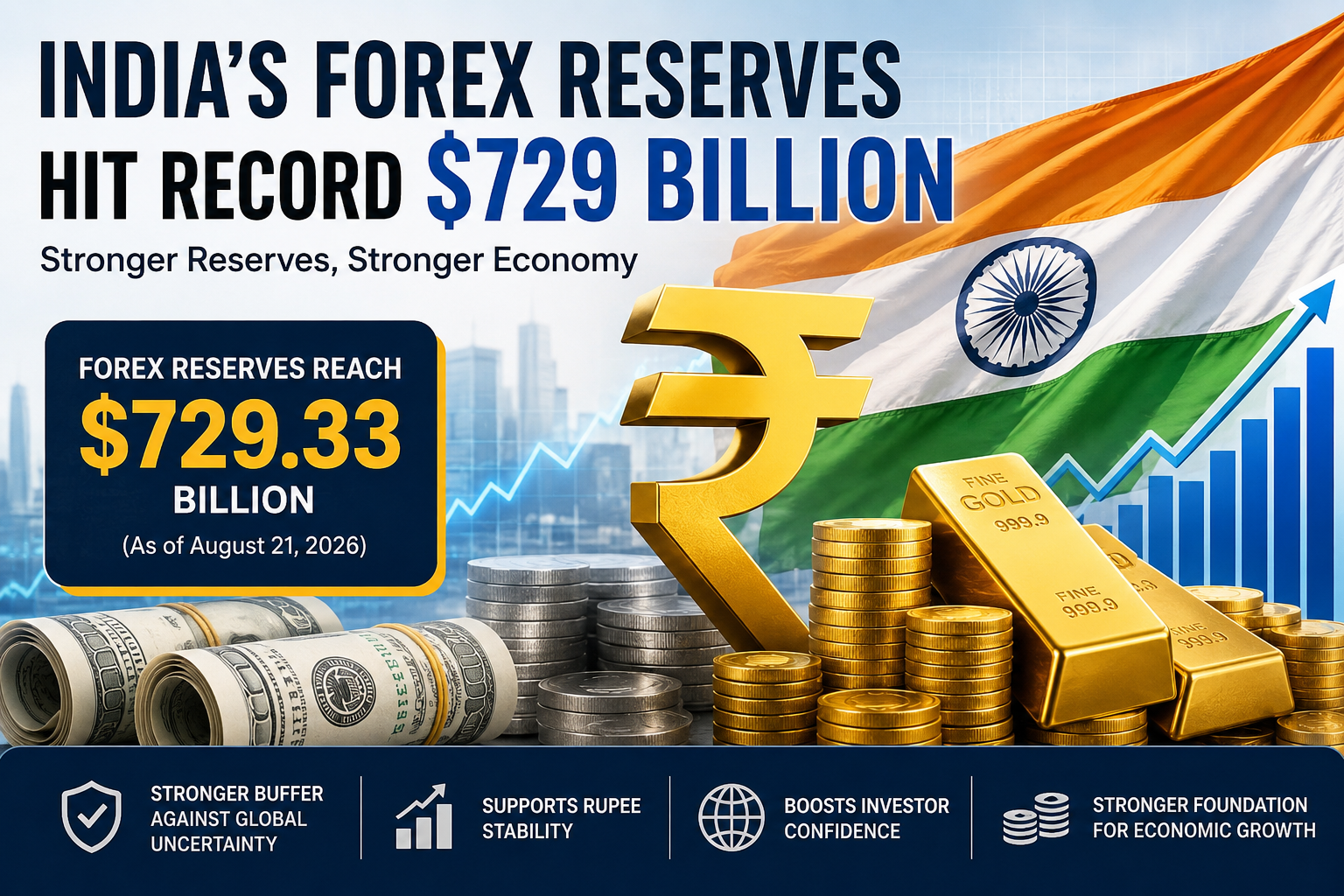
New Delhi: India’s foreign exchange reserves have reached a record level, crossing the $729 billion mark in the week ended August 21, 2026. The rise has attracted attention because foreign exchange reserves are one of the important indicators used to understand a country’s external financial strength.
According to data reported from the Reserve Bank of India, India’s forex reserves stood at around $729.33 billion as of August 21. The reserves increased by about $12.4 billion in the latest weekly data, with foreign currency assets and gold holdings contributing to the rise.
The number is significant for India because a large reserve position gives the country a bigger financial cushion when global markets become uncertain. It can also help the central bank manage sudden movements in the currency market and meet external payment requirements.
But what exactly are forex reserves, why have India’s reserves increased so sharply, and what does this development mean for ordinary people?
Let’s understand it in simple terms.
What Are Forex Reserves?
Foreign exchange reserves are assets held by a country’s central bank in foreign currencies and other internationally accepted forms of value.
In India’s case, the Reserve Bank of India manages the country’s foreign exchange reserves. These reserves generally include foreign currency assets, gold, Special Drawing Rights, and India’s reserve position with the International Monetary Fund.
The purpose is not simply to keep money sitting in an account.
A country’s reserves can act as a financial safety cushion. When there is pressure on the domestic currency or when the country needs to make payments abroad, adequate reserves can provide greater flexibility.
For a country as large as India, which imports crude oil, electronics, machinery, industrial equipment and many other products, having sufficient foreign exchange is particularly important.
India’s Reserves Reach a New Record
The latest figures show that India’s foreign exchange reserves reached approximately $729.33 billion in the week ending August 21, 2026.
Reuters reported that the latest weekly increase was about $12.4 billion. Foreign currency assets increased by around $9.5 billion, while gold holdings rose by about $2.8 billion in value.
This is a notable development because reserves can move up and down from week to week depending on currency movements, capital flows, changes in the value of assets and the central bank’s operations.
Therefore, one week’s record number should not be treated as a permanent guarantee that reserves will continue rising every week.
Still, the current level provides India with a sizeable external buffer.
Why Have Forex Reserves Increased?
There is no single reason behind the increase.
One of the important factors has been foreign currency inflows into India’s financial system.
Reuters reported that regulatory measures introduced earlier in the year helped attract substantial foreign currency inflows, including deposits from non-resident Indians.
According to the report, India had attracted around $65 billion through NRI deposits under the relevant measures by the time of the latest data. The strong inflows contributed to the increase in the country’s foreign exchange position.
The central bank has also been managing the impact of these inflows through its market operations.
Currency markets can be complicated, and a large movement of foreign currency into the country can affect liquidity and the value of the rupee. The RBI therefore has to balance several factors at the same time.
Why Are Foreign Exchange Reserves Important?
For an ordinary person, the term “forex reserves” may sound like something that only matters to economists and financial markets.
In reality, the reserve position can have an indirect impact on many areas of the economy.
India imports a significant amount of crude oil. It also imports gold, electronic components, machinery, chemicals and other goods.
Many of these international transactions are settled in foreign currencies, particularly the US dollar.
If the rupee comes under heavy pressure and the country has limited foreign exchange reserves, managing external payments can become more difficult.
A strong reserve position gives the central bank more room to respond when international financial conditions become challenging.
This does not mean the RBI can permanently control the value of the rupee. Exchange rates are affected by many factors, including global interest rates, oil prices, foreign investment, trade flows and international economic conditions.
But adequate reserves can provide an important layer of protection.
What Does This Mean for the Indian Rupee?
The record forex reserves are generally a positive development for India’s external financial position.
However, it would be incorrect to say that higher reserves automatically mean the rupee will continuously strengthen against the US dollar.
The value of the rupee depends on several factors.
For example, if crude oil prices rise sharply, India’s import bill can increase. Similarly, if foreign investors withdraw money from Indian markets, demand for dollars can rise.
Global interest rates also matter.
When investors find higher returns in another country, international capital can move between markets. These movements can influence currencies.
Therefore, forex reserves should be viewed as one part of the bigger economic picture rather than a single measure that determines the future of the rupee.
A Stronger Cushion Against Global Uncertainty
The global economy has gone through several periods of uncertainty in recent years.
Geopolitical tensions, changes in oil prices, interest-rate decisions by major central banks and fluctuations in international trade can all affect emerging economies.
For India, maintaining a healthy level of foreign exchange reserves can help reduce vulnerability to sudden external shocks.
A large reserve position does not eliminate economic risks, but it can give policymakers more flexibility.
This is particularly important because India is closely connected to the global economy through trade, investment, technology and services.
What Does It Mean for Common People?
The impact on ordinary households is usually indirect.
People do not receive a direct payment because the country’s forex reserves have increased.
However, the reserve position can influence the broader financial environment.
For example, currency stability can affect the cost of imported products. If the rupee loses significant value against the dollar, imported goods and raw materials can become more expensive.
Fuel prices are another important example because India imports crude oil.
A weaker rupee combined with expensive international crude can put additional pressure on domestic fuel costs.
On the other hand, a stable external financial position can give policymakers more room to deal with sudden market pressure.
It is therefore better to think of forex reserves as part of the country’s financial safety net rather than as money that can simply be distributed among citizens.
Gold Also Plays an Important Role
Another interesting part of India’s reserve position is gold.
The latest increase included a rise in the value of India’s gold holdings. Reuters reported an increase of approximately $2.8 billion in gold holdings in the latest weekly movement.
Gold is an internationally recognised reserve asset and is held by many central banks.
Its value can also rise or fall depending on international gold prices.
That means a change in the dollar value of gold holdings does not necessarily mean the RBI physically bought the entire amount of additional gold during that particular week.
Changes in market prices can affect the reported value of reserves as well.
This is an important point that is sometimes missed when weekly reserve figures are discussed.
India’s External Position Has Been Closely Watched
India’s external financial position has become an important subject for investors and economists as the global economic environment continues to change.
The country’s large domestic market provides some support, but India also remains dependent on international trade for several essential commodities.
Oil is a major example.
At the same time, India has a strong services sector, including information technology and business services, which contributes significantly to foreign exchange earnings.
Remittances from Indians living and working abroad are another important source of foreign currency inflows.
Together, these factors play a role in shaping India’s external balance.
Does a Record Reserve Level Guarantee Economic Growth?
Not by itself.
A high forex reserve number is positive, but it is only one part of the economy.
Economic growth also depends on employment, investment, inflation, industrial production, consumer demand, exports, infrastructure and many other factors.
A country can have strong reserves and still face economic challenges.
Similarly, reserves can change because of factors that have little to do with the underlying strength of the domestic economy.
This is why economists generally look at several indicators together rather than focusing on a single number.
What Could Happen Next?
The direction of India’s forex reserves in the coming months will depend on a combination of domestic and global factors.
Foreign investment flows, crude oil prices, imports and exports, remittances, currency movements and global interest rates will all remain important.
The RBI will also continue to monitor liquidity and currency-market conditions.
Recent reporting has shown that the central bank has been adjusting its approach to foreign-currency inflows and liquidity management as banks attracted large amounts of overseas dollar deposits.
This suggests that managing the impact of large capital inflows can itself become an important task for policymakers.
The Bigger Picture
India crossing the $729 billion mark in foreign exchange reserves is an important financial milestone.
The record level provides the country with a substantial external buffer and reflects strong foreign-currency inflows during a period of changing global economic conditions.
At the same time, the figure should be understood in context.
Forex reserves can move in both directions, and a single record week does not determine the long-term direction of the Indian economy.
For readers, the main takeaway is simple: India currently has a very large pool of external reserves, giving the country additional financial strength to deal with global volatility.
The coming months will show whether reserves remain near these levels and how changing oil prices, global interest rates, investment flows and currency movements affect India’s external position.