ISRO EOS-05 Mission 2026: India Reaches Another Milestone in Space
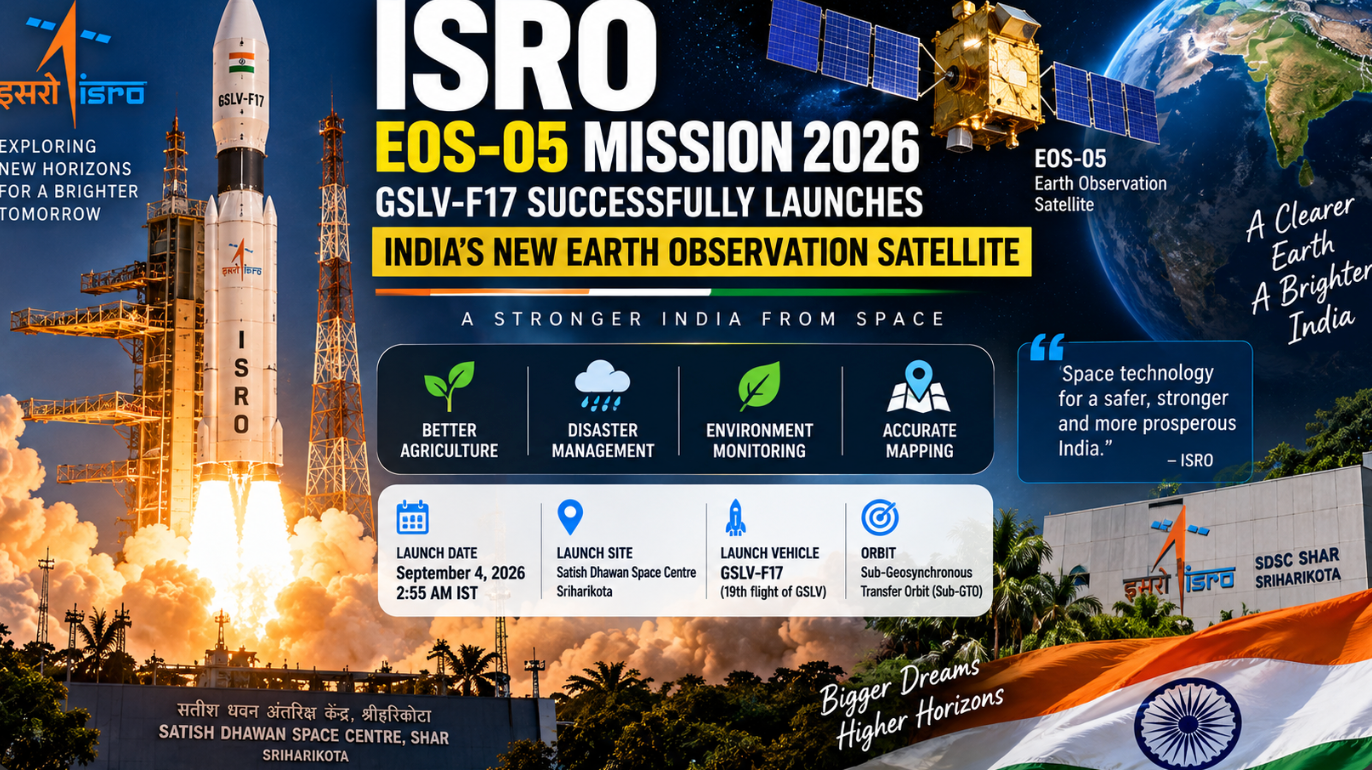
India has achieved another important milestone in its space programme with the successful launch of the GSLV-F17/EOS-05 mission on September 4, 2026.
The Indian Space Research Organisation (ISRO) confirmed that the GSLV-F17 launch vehicle successfully accomplished its mission and placed the EOS-05 Earth observation satellite into its intended orbit. The launch took place from the Second Launch Pad at Satish Dhawan Space Centre, Sriharikota.
The mission has attracted significant attention because EOS-05 is designed for Earth observation and represents an important step in India’s satellite imaging capabilities.
GSLV-F17 Successfully Launches EOS-05
The GSLV-F17 is the latest flight in India’s Geosynchronous Satellite Launch Vehicle programme.
According to ISRO, GSLV-F17 is the 19th flight of India’s GSLV. The rocket carried EOS-05 as its primary payload and successfully placed the satellite into a Sub-Geosynchronous Transfer Orbit (Sub-GTO).
The launch was scheduled for September 4, 2026, at 2:55 AM IST. ISRO’s official website has now confirmed the successful completion of the mission.
The successful launch is another achievement for India’s increasingly capable space programme.
What Is EOS-05?
EOS-05 is an advanced Earth observation spacecraft developed as part of India’s Earth observation satellite programme.
ISRO describes EOS-05 as a state-of-the-art Earth observation spacecraft and says it is India’s first imaging satellite from geosynchronous orbit.
Earth observation satellites are important because they allow scientists and government agencies to collect information about the Earth’s surface and atmosphere.
Such satellite data can support applications involving agriculture, disaster management, environmental monitoring, infrastructure planning and several other areas.
Why Is the EOS-05 Mission Important?
The mission is significant for several reasons.
First, EOS-05 expands India’s capabilities in satellite-based Earth observation.
Second, the mission demonstrates the continued use of the GSLV platform for placing sophisticated spacecraft into higher orbits.
Third, improved Earth observation capabilities can provide useful data for various national applications.
Satellite imagery has become increasingly important in modern decision-making. Governments and organisations can use satellite data to monitor changes on the ground without relying entirely on traditional surveys.
GSLV-F17: Another Important Flight for ISRO
GSLV-F17 is part of India’s GSLV family of launch vehicles.
ISRO states that GSLV is designed to carry heavier spacecraft into geosynchronous transfer orbits. The launcher uses a combination of solid, liquid and cryogenic propulsion stages.
The successful EOS-05 mission therefore also demonstrates India’s continued experience with complex launch operations involving the GSLV platform.
Every successful mission helps ISRO gain additional operational experience and strengthens India’s independent access to space.
From Sriharikota to Orbit
The mission was launched from the Second Launch Pad at Satish Dhawan Space Centre (SDSC SHAR), Sriharikota.
Sriharikota is India’s primary spaceport and has hosted numerous important ISRO missions over the years.
The location is strategically important for India’s launch programme and supports different types of launch vehicles and missions. ISRO describes Satish Dhawan Space Centre as India’s spaceport on the country’s eastern coast.
The EOS-05 launch once again placed Sriharikota in the spotlight as the centre of India’s latest space achievement.
How Earth Observation Satellites Help India
Earth observation satellites have applications far beyond taking photographs of the planet.
Satellite data can be useful for:
- Agriculture and crop monitoring
- Disaster management
- Flood and cyclone assessment
- Environmental monitoring
- Forest and land-use studies
- Water resource management
- Infrastructure planning
- Mapping and geographic information systems
- Monitoring changes on the Earth’s surface
The information collected from space can help authorities understand large areas much faster than conventional ground-based surveys alone.
Importance for Disaster Management
One of the major areas where Earth observation technology can make a difference is disaster management.
When floods, cyclones, landslides or other natural disasters occur, satellite imagery can provide a broad view of affected areas.
This information can help authorities understand the extent of damage and support planning for relief and recovery operations.
India faces a variety of natural hazards every year, including floods, cyclones and landslides. Better satellite observation can therefore play an important role in improving preparedness and response.
Benefits for Agriculture
Agriculture is another important area where Earth observation satellites can be useful.
Satellite-based observations can help monitor crop conditions, land use and changes in vegetation over large areas.
Instead of examining every field individually, satellite information can provide a wider picture that can support agricultural planning and research.
This is particularly valuable for a country like India, where agriculture remains an important part of the economy and rural livelihoods.
Environmental Monitoring
EOS-05 can also contribute to India’s broader Earth observation capabilities.
Satellite-based monitoring allows scientists to study changes across large geographical areas.
Forests, water bodies, land cover and other environmental features can be monitored over time.
Such information can support research into environmental changes and help policymakers make better-informed decisions.
India’s Growing Space Programme
The EOS-05 mission comes at a time when India’s space programme is expanding across multiple areas.
ISRO has been working on Earth observation, navigation, communication, scientific exploration and human spaceflight missions.
The organisation’s recent missions have included the NASA-ISRO NISAR satellite, India’s SpaDeX docking demonstration and other satellite launches.
The successful GSLV-F17/EOS-05 mission adds another important achievement to this growing list.
What Makes This Mission Different?
One of the most notable aspects of EOS-05 is its intended imaging role from a geosynchronous orbit.
ISRO specifically describes EOS-05 as India’s first imaging satellite from geosynchronous orbit.
This makes the mission particularly interesting from a technology perspective.
Different satellite orbits offer different advantages depending on the purpose of a spacecraft. Selecting the appropriate orbit is an important part of mission design because it determines how a satellite observes and communicates with Earth.
ISRO Confirms Mission Success
The most important update for readers is that the mission is no longer simply a planned launch.
ISRO’s official website confirms that GSLV-F17 successfully accomplished its mission and placed EOS-05 into the intended orbit.
The successful completion means the launch phase achieved its primary objective.
Further information about the satellite’s operations and the data it produces will help demonstrate the mission’s long-term value.
What Happens After the Launch?
After a satellite reaches its intended orbit, several activities are required before it becomes fully operational.
Spacecraft systems need to be checked and configured, communication links established and various instruments assessed.
These activities are important because reaching orbit is only one part of a satellite mission.
Once the spacecraft completes the required commissioning activities, its Earth observation capabilities can be used for the applications for which it was designed.
India’s Space Sector Continues to Expand
India’s space programme is no longer limited to government missions.
The country’s space ecosystem has expanded to include private companies, startups, research organisations and commercial space activities.
ISRO and associated organisations are increasingly working toward strengthening India’s position in the global space sector.
Successful missions such as GSLV-F17/EOS-05 can contribute to this broader ecosystem by demonstrating India’s capabilities in launch vehicles, satellite development and mission operations.
What This Means for Ordinary Citizens
A space mission may appear far removed from everyday life, but satellite technology can have practical benefits.
Weather forecasting, navigation, disaster response, agriculture, telecommunications and mapping all depend to varying degrees on space-based technologies.
Better Earth observation can help improve the information available to governments and researchers.
Over time, the data generated by satellites can therefore support services and decisions that indirectly affect millions of people.
Conclusion
The ISRO EOS-05 Mission 2026 has successfully added another milestone to India’s space programme.
The GSLV-F17 rocket successfully launched EOS-05 on September 4, 2026, and ISRO confirmed that the satellite was placed into its intended orbit.
EOS-05 is an advanced Earth observation spacecraft, and ISRO describes it as India’s first imaging satellite from geosynchronous orbit.
The mission is important not only because of the successful launch but also because of the potential applications of Earth observation technology in areas such as agriculture, disaster management and environmental monitoring.
For India’s space programme, GSLV-F17/EOS-05 represents another step toward building stronger and more advanced capabilities in space.
India’s latest space milestone has once again put Sriharikota and ISRO in the global spotlight.
FAQs
When was the ISRO EOS-05 satellite launched?
EOS-05 was launched on September 4, 2026, aboard the GSLV-F17 launch vehicle.
Was the GSLV-F17 mission successful?
Yes. ISRO confirmed that GSLV-F17 successfully accomplished its mission and placed EOS-05 into its intended orbit.
What is EOS-05?
EOS-05 is an advanced Earth observation satellite developed by ISRO.
Where was EOS-05 launched from?
The mission was launched from the Second Launch Pad at Satish Dhawan Space Centre, Sriharikota.
What is the purpose of EOS-05?
EOS-05 is designed for Earth observation and satellite imaging applications. ISRO describes it as India’s first imaging satellite from geosynchronous orbit.
Why is the EOS-05 mission important?
The mission strengthens India’s Earth observation capabilities and demonstrates another successful GSLV mission.
ISRO EOS-05 Mission 2026: GSLV-F17 successfully launched EOS-05 on September 4. Know the launch details, satellite purpose, Earth observation capabilities and why this mission matters for India.