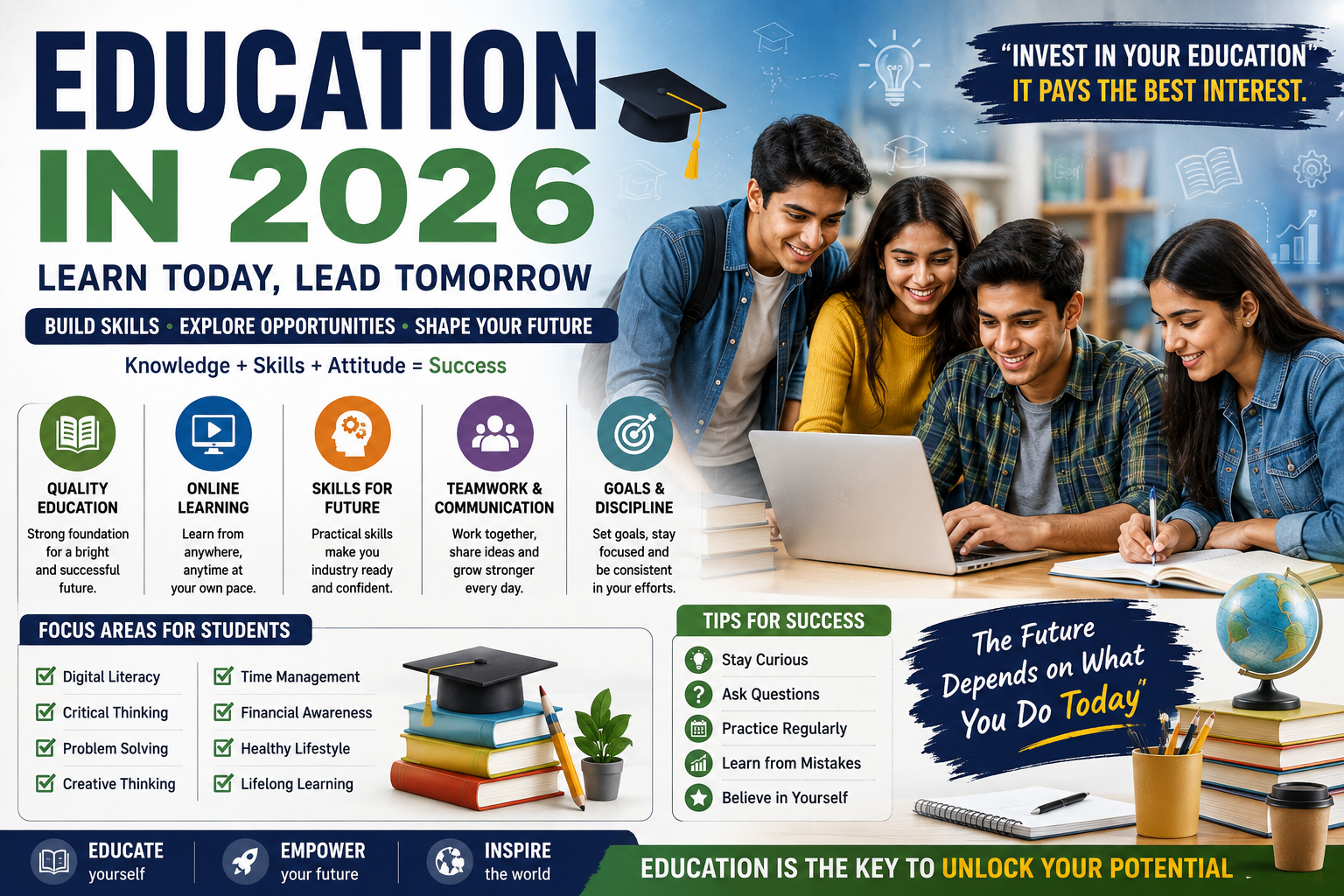
Education is changing faster than it was a few years ago. Students today are not only expected to complete their school or college education, but also to develop practical skills that can help them in higher studies and future careers.
With technology becoming part of almost every profession, students have more learning opportunities than ever before. At the same time, choosing the right skills and using online resources properly can be confusing.
This article looks at some important education trends in 2026 and explains how students can prepare themselves for the future without putting unnecessary pressure on themselves.
Why Education Is Changing
The traditional idea of education was mostly based on attending classes, taking examinations and earning a degree. These things are still important, but the requirements of the modern workplace are becoming broader.
Employers in many industries are looking for people who can communicate clearly, solve problems, understand technology and learn new things when required.
This does not mean that degrees are becoming useless. Instead, academic qualifications and practical skills are increasingly working together.
For a student, this creates both an opportunity and a responsibility. Learning does not have to stop when the school or college day ends. Students can use books, educational websites, online courses, tutorials and practical projects to understand subjects in a deeper way.
Technology Is Becoming a Bigger Part of Learning
Technology has already changed the way students study. Digital classrooms, educational applications, online lectures and interactive learning materials have made information easier to access.
A student living in a small town can now learn from educational resources created by teachers and experts from different parts of the country and even other parts of the world.
Artificial intelligence is also becoming part of the education discussion. AI-based tools can help students understand difficult concepts, organize notes, practice questions and explore topics from different perspectives.
However, technology should be used as a learning assistant rather than a replacement for thinking.
For example, simply copying an answer from an online tool may help complete an assignment, but it does not necessarily help the student understand the subject. Students get much more value when they use technology to ask questions, compare explanations and then write answers in their own words.
Practical Skills Matter Alongside Academic Education
One of the biggest changes in education is the growing importance of practical knowledge.
A student studying commerce, for example, can learn basic spreadsheet skills, financial concepts and communication. Someone interested in technology can practice programming or website development. Students interested in media can learn writing, editing, photography or video production.
These skills do not necessarily need to be mastered all at once.
It is better to choose one area of interest and practice it regularly. Even 30 to 60 minutes of focused practice several times a week can make a difference over a longer period.
Practical projects are particularly useful because they give students a chance to apply what they have learned.
Communication Skills Are Still Important
Technology may change the way people work, but communication remains one of the most useful skills.
Students who can explain their ideas clearly often find it easier to participate in discussions, interviews, presentations and group projects.
Communication does not only mean speaking fluent English. It also includes listening carefully, writing clearly, asking relevant questions and explaining an idea in a simple way.
Students can improve these skills by reading regularly, writing short articles, participating in discussions and practicing presentations.
For students who are not confident initially, there is no need to worry. Communication is a skill, and like other skills, it improves with regular practice.
The Importance of Reading
Reading is sometimes overlooked because students have access to short videos and quick online content.
However, reading still plays an important role in education.
Books, newspapers, magazines and reliable online publications can help students improve vocabulary and develop a better understanding of different subjects.
Reading also teaches students to follow an argument and understand information in context. This becomes especially useful when preparing for competitive examinations or higher education.
A student does not need to start with a large book every week. Reading for 15 or 20 minutes each day is a simple way to develop the habit.
Online Learning Has Opened New Opportunities
Online education has made learning more flexible.
Students can find courses covering subjects such as programming, design, business, mathematics, languages, writing and many other areas.
One advantage of online learning is that students can learn at their own pace. A difficult lesson can be watched again, while familiar topics can be completed more quickly.
But there is one common problem: having too many choices.
Students sometimes enroll in several courses but do not finish any of them. A better approach is to choose one useful course, create a realistic schedule and complete it before moving to another.
Certificates can be useful, but the knowledge gained from the course is more important in the long run.
Education and Career Planning
Career planning does not have to mean deciding your entire life at the age of 15 or 18.
Interests can change, and new career options continue to appear.
Instead of worrying about finding the perfect career immediately, students can focus on understanding their strengths.
For example, someone who enjoys explaining ideas may be interested in teaching, communication or content-related fields. A student who enjoys solving logical problems might explore technology, mathematics or engineering.
Talking with teachers, parents, professionals and career counselors can also help students understand different options.
The important thing is to collect information before making major decisions.
Students Should Avoid Unnecessary Pressure
Education can sometimes become stressful when students compare themselves with classmates or people they see on social media.
Every student has a different learning speed and different circumstances.
One student may perform very well in examinations, while another may be better at practical activities, communication, sports, art or technology.
Marks are important in many academic situations, but they are not the only measure of a person’s abilities.
A balanced approach is healthier. Students should set realistic academic goals while also making time for sleep, physical activity, hobbies and family.
Teachers Continue to Play an Important Role
Even with the growth of digital education, teachers remain an important part of learning.
A good teacher does more than explain a textbook. Teachers can identify where students are struggling, answer questions and encourage them to think independently.
Technology can provide information quickly, but human guidance can help students understand how to use that information responsibly.
This is why the future of education is likely to involve a combination of classroom teaching, digital resources and practical learning rather than one method replacing everything else.
How Parents Can Support Students
Parents can support education by creating an environment where students feel comfortable asking questions.
Constantly comparing a child with another student can sometimes create unnecessary pressure. Instead, parents can focus on improvement and encourage consistent study habits.
Simple things can make a difference: providing a quiet place to study, discussing educational goals and encouraging reading or practical activities.
Parents do not need to know every new technology or career option themselves. Listening to the student and helping them find reliable information can be equally valuable.
What Students Can Start Doing Today
Students who want to prepare for the future can start with a few simple habits:
- Spend some time reading every day.
- Improve writing and communication skills.
- Learn basic digital skills.
- Practice one useful skill consistently.
- Use online learning resources carefully.
- Ask questions instead of memorizing everything.
- Create small practical projects.
- Keep track of academic goals.
- Avoid unnecessary comparison with others.
- Maintain a healthy balance between study and personal time.
None of these habits require expensive equipment or complicated plans.
Consistency is usually more important than doing everything at once.
The Future of Education
The future of education is likely to be more flexible and skill-focused. Students may have more ways to learn than previous generations, but they will also need to become better at identifying reliable information.
The ability to learn independently could become one of the most valuable skills.
A student may graduate with a particular qualification, but technology and industries can change during their career. People who remain curious and willing to learn can adapt more easily.
This is why education should not only prepare students for their next examination. It should also help them develop the confidence and ability to continue learning throughout their lives.
Conclusion
Education in 2026 is about more than classrooms, textbooks and examinations. Academic knowledge remains important, but practical skills, communication, technology awareness and independent learning are becoming increasingly valuable.
Students do not need to learn everything at once. Choosing a few meaningful goals and working on them consistently can be a much better approach.
The most important thing is to stay curious, use technology responsibly and keep improving step by step.
The future may bring new careers and new challenges, but the ability to learn, adapt and apply knowledge will remain valuable in almost every field.